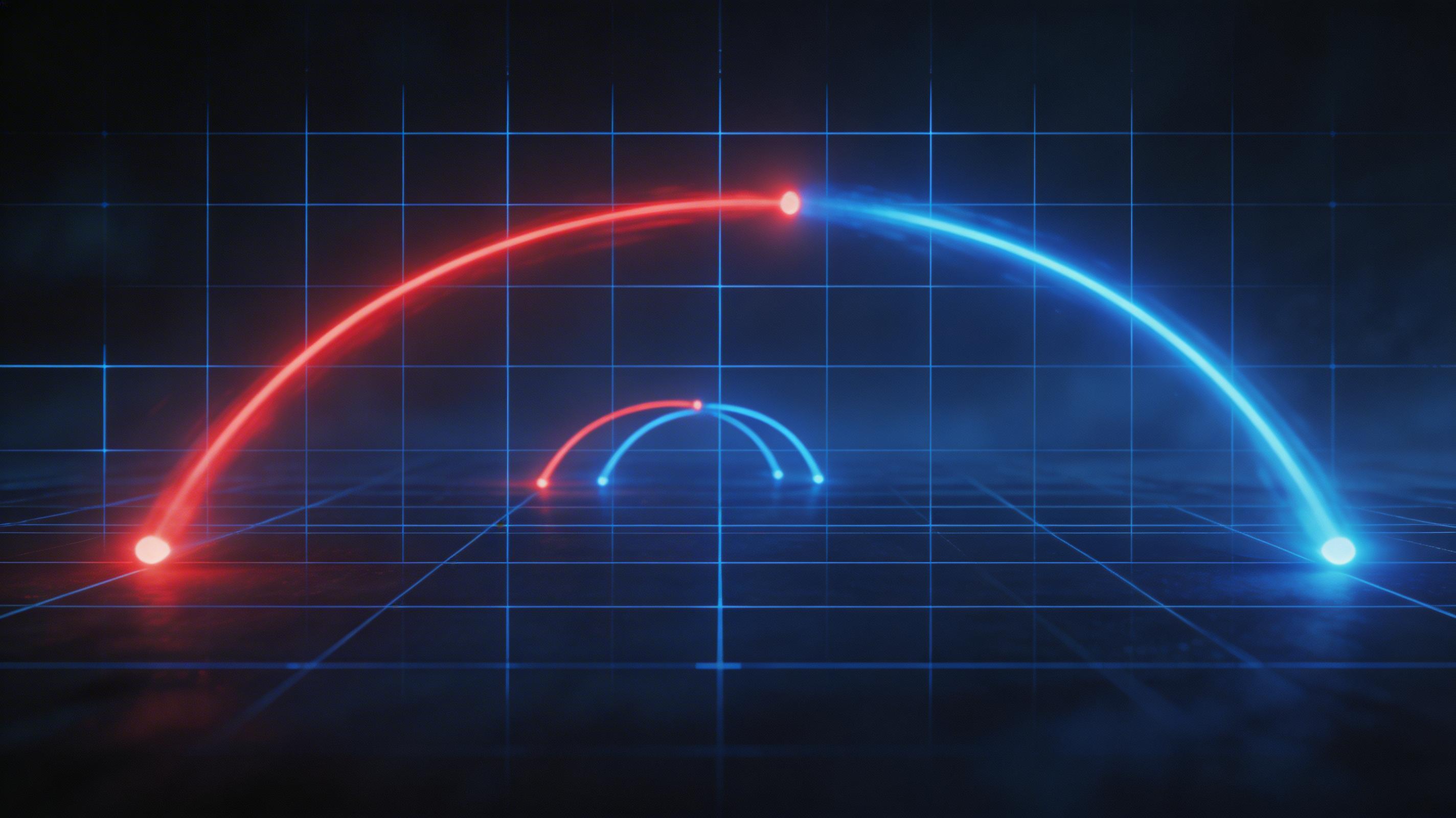
In the world of arcade physics games, success is rarely a matter of luck. Whether you're aiming a basketball, launching a projectile, or calculating a bounce, you're essentially solving a series of quadratic equations in real-time. This guide will deconstruct the underlying physics and provide you with the mental tools to master any trajectory-based challenge. In the 2026 gaming landscape, where physics engines have reached near-simulation levels of fidelity, understanding these principles is the difference between a casual player and a tactical master.
1. The Parabolic Path: Quadratic Intuition
Every projectile launched in a standard gravity field follows a parabolic trajectory. This is the fundamental law of motion that governs games like Basketball Crazy or DunkLine. The path is determined by two primary vectors: the initial velocity and the angle of launch. Gravity, a constant downward force, acts only on the vertical component of the velocity, while the horizontal component remains constant (ignoring air resistance). This "Decoupled Motion" is the first thing a strategist must internalize.
To master this, you must develop an intuitive feel for "Apex Calculation." The apex is the highest point in a projectile's flight, and it occurs exactly halfway through its horizontal travel in a level field. By focusing on where you want the apex to be, you can more accurately predict the landing point. In games with moving targets, you have to account for the "Time of Flight" (TOF), which is the total duration the projectile is in the air. The TOF is determined solely by the initial vertical velocity and the force of gravity. If you want to hit a moving target, you must aim for the target's future position at T+TOF. This "Temporal Aiming" requires you to look not at where the target is, but where the math says it will be.
Advanced players also consider "Drag Coefficients." While often simplified in browser games, 2026's top-tier simulations include rudimentary air resistance. This means your horizontal velocity is *not* constant, but decays over time. This turns your perfect parabola into a "Leaning Curve," where the descent is steeper than the ascent. Mastering this "Aerodynamic Decay" is crucial for long-range shots where the effect of drag becomes more pronounced.
2. The Geometry of the Bounce: Reflection and Dissipation
When a projectile hits a surface, the "Angle of Incidence" is equal to the "Angle of Reflection." This is a basic rule of optics that applies equally to physics-based games. However, in games like Blumgi Ball, surfaces aren't always perfectly elastic. The "Coefficient of Restitution" (COR) determines how much energy is lost during a collision. A high COR means a bouncy surface; a low COR means a dead bounce. Understanding the material properties of the simulation's surfaces is a core part of your tactical intel.
Expert players use "Friction Manipulation" to control the spin of the ball. While most browser games use simplified physics, many 2026 titles include a rudimentary friction model. By launching a projectile at a shallow angle, you can induce a "Skid" that changes the angle of reflection. This is particularly useful for navigating tight corridors where a standard bounce would lead to a collision with an obstacle. Understanding the surface material is key: metal walls have a higher COR than wooden ones, and rubberized pads provide a predictable boost that can be used to clear large gaps. This "Surface Intelligence" allows you to use the environment as an extension of your own trajectory.
Furthermore, consider "Energy Stacking." In some puzzle games, a series of quick bounces can actually *increase* the projectile's velocity if hit at the right frequency. This "Resonant Acceleration" is a high-level technique used to bypass speed gates or break through reinforced barriers. It requires a frame-perfect understanding of the game's collision detection and momentum transfer logic.
3. Accounting for External Forces: Vector Compensation
The most common external force in arcade games is wind. Wind acts as a constant acceleration in a specific direction, altering the parabolic path into something more complex. In games like FootballKick3D, wind can be your greatest ally or your worst enemy. The trick to countering wind is "Vector Compensation." If the wind is blowing from the left, you must aim to the left of your target. The amount of compensation depends on the TOF; the longer the projectile is in the air, the more time the wind has to act upon it. This is why "Flat, High-Velocity" shots are more resistant to wind than "Lofty, Slow" ones.
Another force to consider is "Drag." Drag is a resistive force that acts opposite to the direction of motion and increases with the square of the velocity. In high-speed racing or projectile games, drag can significantly shorten your range. The 2026 "Physics Pro" update for many popular titles introduces "Variable Drag," where the shape and orientation of your projectile change its aerodynamic profile. Mastering this requires a more nuanced approach to launch power: sometimes a slower, more stable launch is more accurate than a high-speed one that will be heavily affected by drag. This "Aerodynamic Awareness" is a hallmark of the modern digital strategist.
We also see the introduction of "Gravity Wells" in some abstract strategy titles. These are points on the map that exert a pull on any nearby projectile, bending its trajectory in real-time. Navigating a "Gravitational Minefield" requires you to constantly adjust your vectors, often mid-flight if the game allows for boosters or corrections. This is physics at its most dynamic, where the environment is as active as the player.
4. The Mental Model of Simulation: Predictive Mastery
Ultimately, mastering arcade physics is about building a robust mental simulation. You're not just reacting to what's on the screen; you're predicting what will happen. This requires "Calibration." At the start of every new level or game session, take a few "Throwaway Shots" to test the physics engine. How fast is gravity? How much energy is lost on a bounce? How strong is the wind? This "Data Gathering Phase" is essential for building an accurate internal model of the current sector.
Once you've calibrated your mental model, you can begin to execute "Complex Sequences." These are shots that involve multiple bounces, mid-air adjustments, or interactions with moving platforms. The key is to break the sequence down into its component parts. Solve for the first bounce, then use that result as the initial state for the next segment of the flight. This "Modular Approach" makes even the most daunting puzzles manageable. With practice, these calculations become second nature, allowing you to pull off incredible feats of precision that look like magic to the uninitiated. This is the essence of "Predictive Mastery"—where the player and the simulation are in perfect alignment.
Finally, we must address "Feedback Integration." Every miss is an opportunity to refine your mental model. If your shot fell short, was it because you underestimated gravity or overestimated your launch power? If it drifted right, was it the wind or a slight angle error? Elite players use "Post-Shot Analysis" to constantly tune their intuition. In the mmm community, we share these insights in our "Sector Debriefs," helping each other build the most accurate physics models in the world.
Mastering physics is a lifelong pursuit in the digital realm. It is a journey from reactive clicking to predictive engineering. Visit our Sector Analysis to find the perfect laboratory for your next experiment and join the ranks of the tactical masters.